Disambiguating 2D-3D Correspondences in Gaussian Splatting-based Feature Fields for Visual Localization

Miso Lee Sangeek Hyun Yerim Jeon Jae-Pil Heo†

†: Corresponding author
Sungkyunkwan University
NeurIPS 2026

Title Image

TL;DR: SplitGS-Loc exploits Gaussian attributes for localization, stabilizing the Perspective-n-Point algorithm and achieving strong localization accuracy and mapping efficiency.

Abstract

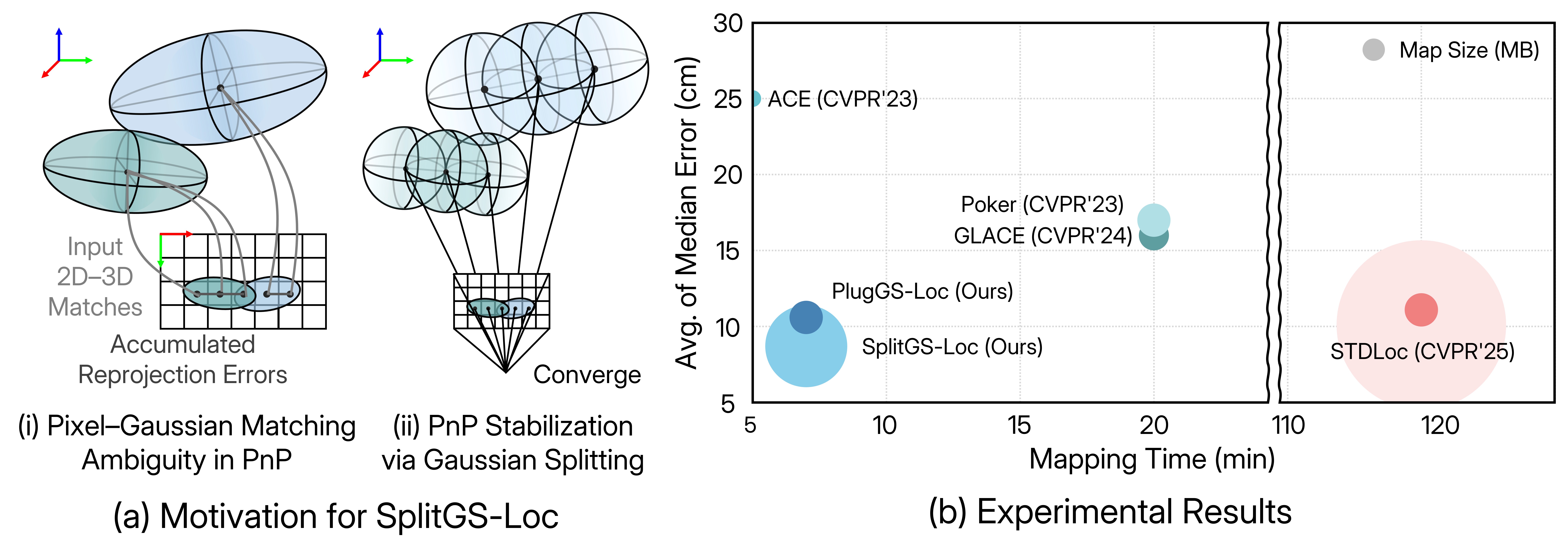
While Gaussian Splatting-based Feature Fields (GSFFs) have shown promise for visual localization, this paper highlights that photometrically optimized GSFFs are inherently not suitable for 2D-3D matching. The volumetric extent of each Gaussian induces many-to-one pixel-to-point mappings that destabilize PnP-based pose estimation, while photometric optimization gives rise to superfluous Gaussians devoid of multi-view consistency.

To address these issues, we propose SplitGS-Loc, a GSFFs construction framework for localization, which disambiguates 2D-3D correspondences by exploiting Gaussian attributes.

  • Our key design, Mixture-of-Gaussians-based splitting, decomposes each Gaussian into smaller Gaussians, replacing ambiguous many-to-one with precise one-to-one correspondences.
  • In parallel, we exploit composition weights from GS rasterization to select Gaussians that significantly and consistently contribute across multiple views and aggregate discriminative features through strong pixel-Gaussian associations.

The resulting compact yet discriminative feature fields enable stable PnP convergence, achieving competitive performance on localization benchmarks. Extensive experiments validate that SplitGS-Loc extends the utility of photometric GSFFs to accurate and efficient localization by exploiting Gaussian attributes, without per-scene training for feature fields or iterative pose refinement.
Overall Framework

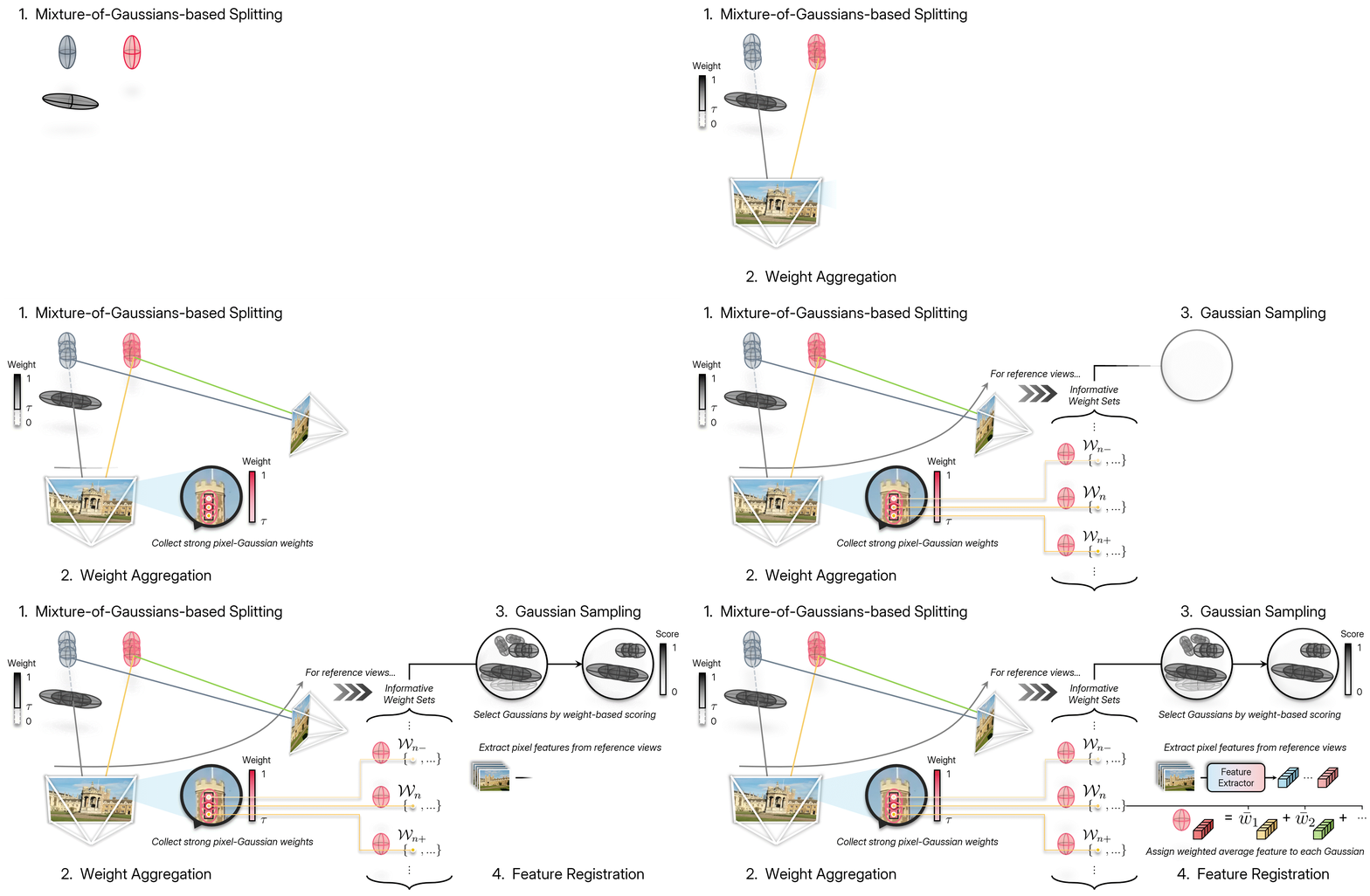
  1. Mixture-of-Gaussians-based Splitting: Make more room for features
  2. Select primary Gaussians that significantly and consistently contribute across views
  3. Assign a weighted average feature to each Gaussian, using strong pixel-Gaussian correspondences
Given 3DGS, the whole process takes about a minute per scene.

Lightweight, Fast, and Accurate Visual Localization

Exploiting Gaussian attributes and disambiguating 2D-3D correspondences, we do not require
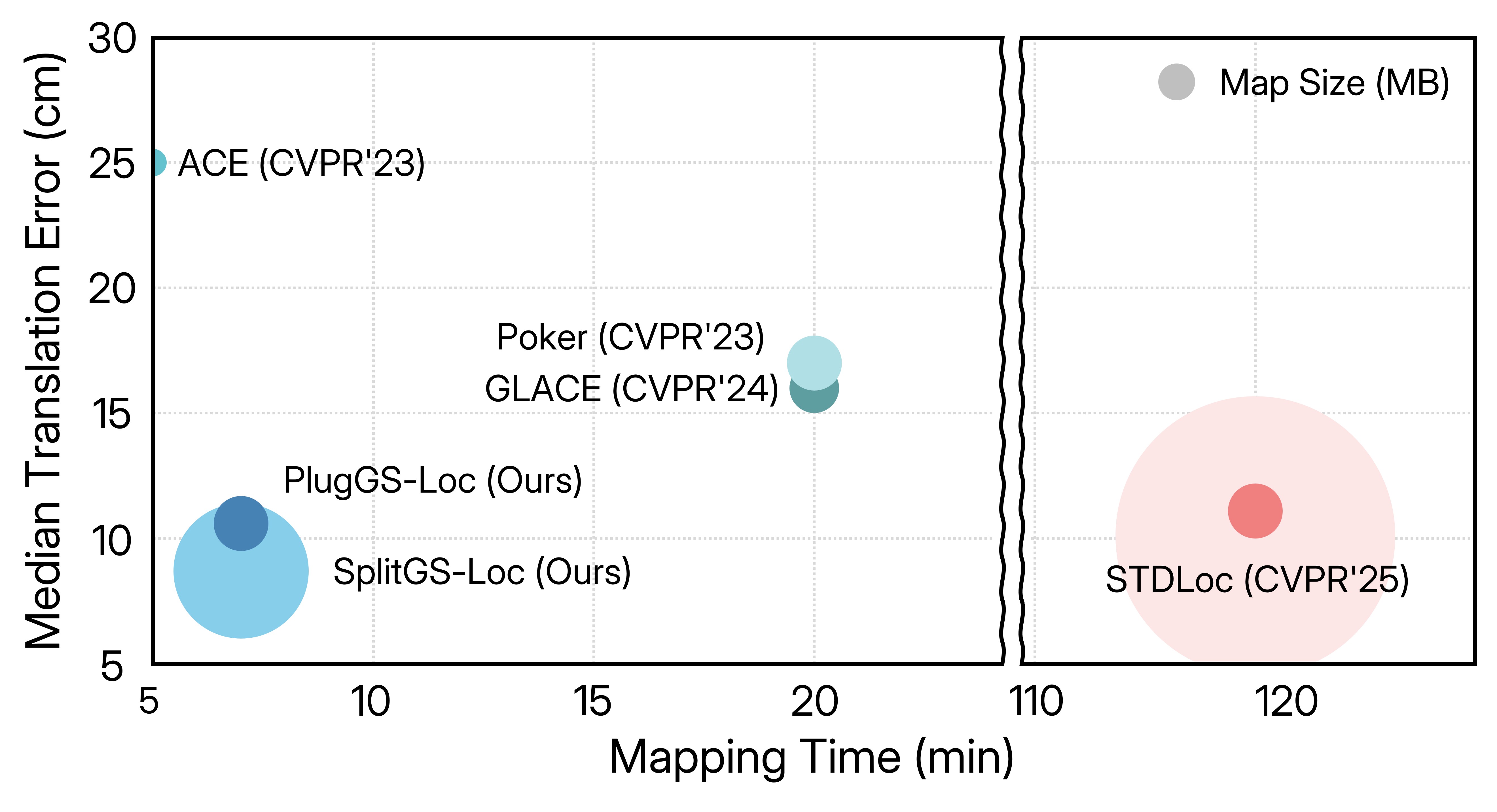
  • Camera pose refinement with iterative rendering
  • full RGB Gaussians and corresponding feature maps
  • multi-stage optimization of feature fields and neural networks
for accurate localization.

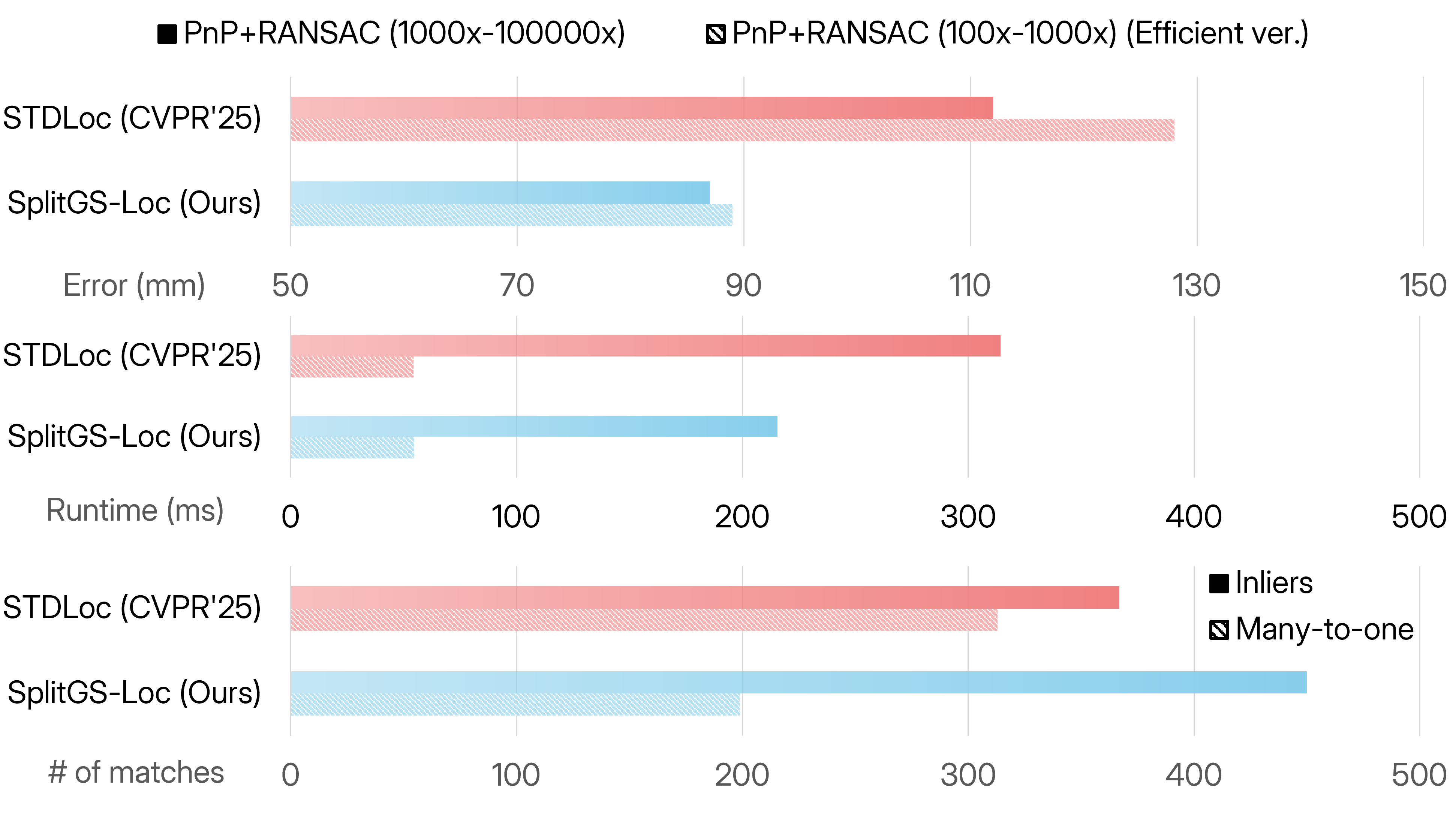
Stabilizing Perspective-n-Point and RANSAC Algorithm

Fewer many-to-one matches and more valid matches lead to more robust performance under various RANSAC settings.
Citation

@article{lee2026splitgsloc,
  title={Disambiguating 2D-3D Correspondences in Gaussian Splatting-based Feature Fields for Visual Localization},
  author={Lee, Miso and Hyun, Sangeek and Jeon, Yerim and Heo, Jae-Pil},
  journal={arXiv preprint arXiv:2605.07351},
  year={2026}
}